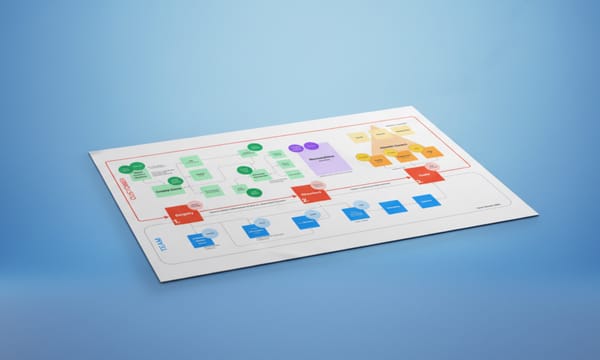
Most ecommerce brands chase growth through tactics: the latest ad platform, a viral campaign, growth hacks that promise instant results. But sustainable demand doesn't come from tactics. It comes from getting eight fundamental things right.
This framework covers the core areas that determine whether your ecommerce brand builds lasting customer relationships or burns through cash chasing the next quick win: brand positioning, creative strategy, data measurement, customer definition, product offers, customer experience, channel effectiveness, and leverage assessment.
These aren't separate initiatives. They're interconnected parts of a system. When one is weak, the others compensate. When all eight work together, demand compounds naturally.
The brands that scale sustainably aren't doing anything revolutionary. They're doing the fundamentals consistently, making small improvements that compound over time, and staying focused on what actually matters: understanding their customers and removing friction from the path to purchase.
1. Brand Positioning and Messaging
Positioning is a filter.
It attracts the right people by being specific about who we serve.
When we say "we're for ambitious professionals who value craftsmanship," we create clarity. That clarity helps people self-select. They know immediately if this is for them.
The brands that stick have clear answers to simple questions.
- What do we believe?
- What won't we compromise on?
- What promises do we keep?
If our team can answer these in one sentence, our customers will too.
Brand authenticity means our inside matches our outside.
Warehouse staff describe the brand the same way the CEO does.
The return policy reflects the same values as the brand’s social posts.
Start here: write down three things your brand will never do, even if it costs sales. Now make sure everything you create respects those boundaries.
2. Creative & Content
Create content that answers questions people are actually asking.
The real ones.
The awkward ones.
The ones hiding in your customer support tickets.
Spend time where your customers hang out.
Read their reviews, not just of your own brand and products but of your competitors and the entire category.
Notice what frustrates them.
Notice what they celebrate.
Create content that speaks to those moments.
A founder's honest thread about their biggest mistake often drives more sales than a polished campaign.
One connects, the other impresses.
Connection wins every time.
Good content starts with good listening.
Ask "will this be useful to one person?" If yes, publish it.
3. Data and Measurement
Choose your North Star metric. The one number that tells you when you're winning and more importantly, when you're not.
For most brands it's MER (marketing efficiency ratio), conversion rate, average order value or repeat purchase rate.
For others it's CAC, cost to acquire a new customer or CPO, the cost per order.
It depends on your model, your margins, your stage.
Then pick two or three supporting metrics that tell you why that North Star is moving.
Focus there.
When conversion rate drops, get curious. What’s changed? What did your competition launch? Does your product still solve the problem it solved six months ago?
Data is imperfect and rarely taken on face value.
Mix it with your knowledge of the business and market to form judgements.
Have you seen what a customer journey looks like? It’s fascinating. There can be two, five, twenty touch-points before a purchase is made.
The goal is faster insight because perfect measurement doesn’t exist.
4. Target Customer Definition
Ask better questions.
What problem keeps your best customers up at night? What are they trying to become? What trade-offs are they willing to make?
Your target customer should be specific enough that you can imagine their lives and environment: What's in their home? What apps are on their phone? What podcast did they listen to this morning?
Interview ten of your best customers. Actual conversations, not surveys. You'll learn more in those ten hours than in six months of analytics.
Listen for patterns and then build for those patterns.
5. Product Offer Strategy
Value is in the benefit to the customer: what it adds, replaces or the pain it removes.
A $200 water bottle makes sense for someone with a $10k a year gym membership.
Your offer is the entire promise: What do they get? When do they get it? What happens if it doesn't work? How easy is it to say yes?
Strong offers remove friction and add certainty. Free returns eliminate the risk of wrong choices. Pay-over-time options make for a smaller decision.
Test offers. Keep what works. Remove what doesn’t. Simplify whenever you can.
6. Quality of the Customer Experience
Our only job in ecommerce is to design the ideal customer experience, clear the path to purchase and then get out of the way.
Every touchpoint matters. Every page. Every word and image. Every email. Every interaction with customer service. Good and not-so good.
Map the customer journey. Where’s the path. Is it clear? Are we adding unnecessary noise and distraction? Where do they get confused? What unspoken questions aren’t we answering? Where do they need help?
Fix the biggest pain point. Then the next one. And so on.
Small conveniences build trust. Every improvement compounds. The brands that win are the ones who constantly iterate and improve consistently, over time.
Focus on the moments that matter. Make them effortless. Make them memorable.
7. Channel Effectiveness
Every ecommerce channel has a job to do.
There are three types: paid, owned and earned.
Like it or not, paid media is still the most effective tool for driving qualified traffic to your store. It allows us to test, optimise and broadcast at scale.
Owned channels such as our email list, blog, Youtube channel, social communities… build relationships. They're slow. They compound. They're where you connect with your customers and have conversations.
Earned media gives your brand credibility. Someone else vouching for you carries weight. Reviews, word of mouth, PR, social comments… all these build trust that can't be manufactured.
Build strength across all three:
- Paid reaches people.
- Owned keeps them.
- Earned convinces them.
The channel mix evolves. Platforms change, costs shift, audiences migrate. Stay curious. Test regularly. Go where your customers actually spend time.
8. Leverage and Gaps
Every business has constraints. Find yours.
There’s always one bottleneck that matters more than everything else. Maybe it's traffic. Maybe it's conversion. Maybe it's repeat purchase rate. Maybe it's margin.
Find it. Then ask: what can I do right now that will make the biggest difference?
Run this exercise regularly: list everything you're doing.
Most strategies succeed when they're focused. Dilution across too many priorities probably won’t move the needle as much as you need.
The most important gap to close is between what you think customers want and what they actually want. Close that gap and everything else becomes easier.
Talk to customers. Watch how they use your product. Ask why they chose you. Ask what almost made them choose someone else.
Build from there.