Simplify, Structure & Scale: The 3 Stages of Ecommerce Growth

– 5 min read
That's the first thing we learn when we try to grow an ecommerce business is that chaos doesn’t scale too well. We add a few more products because we’re not gaining traction with the others, more channels because, well, more chances to sell, more people, processes, apps and platforms until we begin to notice that nothing works quite the way it used to.
What got us here won’t necessarily get us there.
But there’s a method. Most brands follow a predictable path. Three stages, really. Repeated continuously over and over again.
Early on, everything is an opportunity. Should we sell on Amazon? Try TikTok? Add this product line? Partner with that influencer? Use this app? That platform?
The answer is usually no.
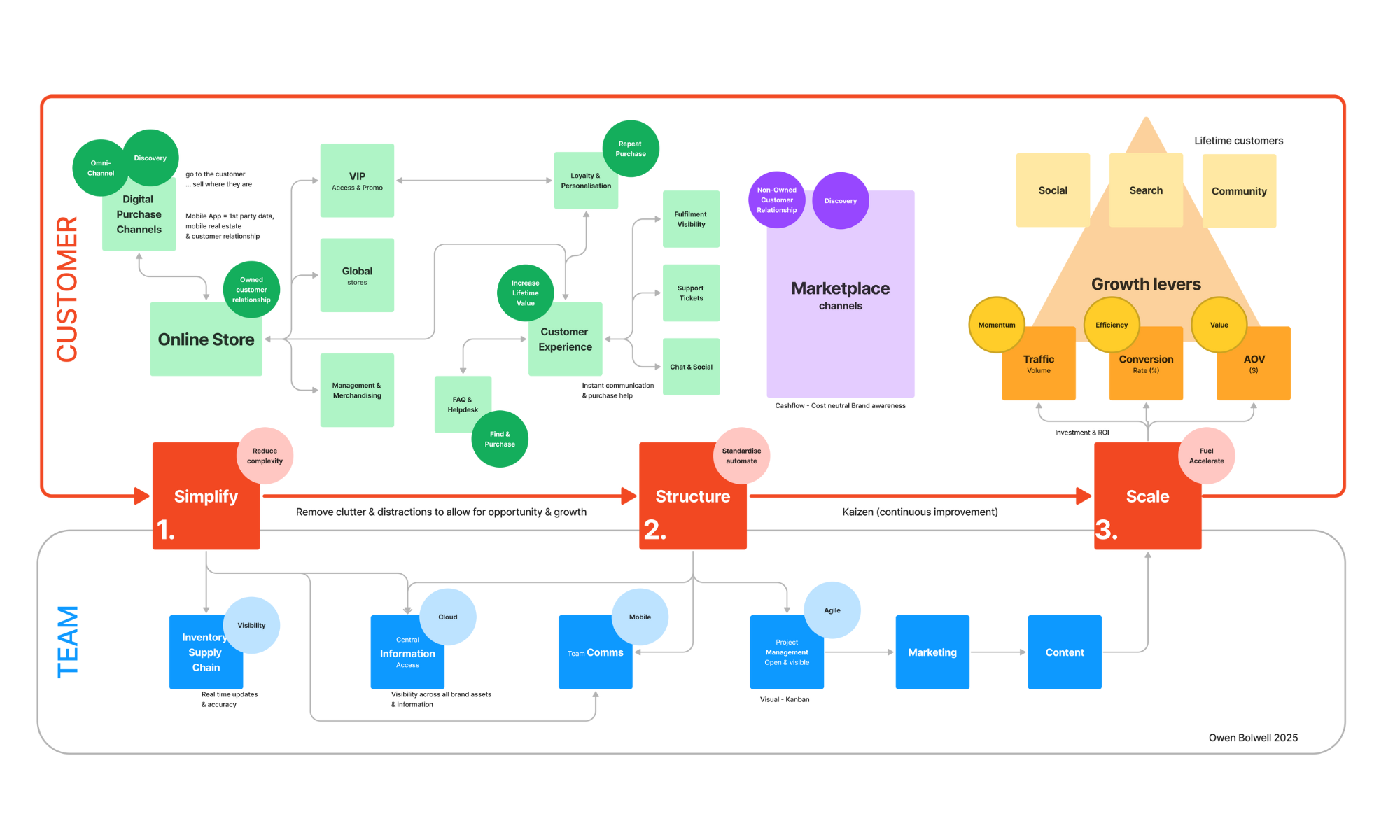
Simplify means removing distraction.
It means owning your customer data instead of renting it through marketplaces. It means focusing on your digital purchase channels, your online store, the direct relationship between you and the person buying from you. Get these right first.
Here's what matters at this stage:
When someone buys from you on Amazon, that's Amazon's customer. When they buy from your store, that's your customer. You get their email, their preferences, their lifetime value potential. This distinction matters more than almost anything else.
Real-time visibility into what you have, where it is, and when it's moving.
Discovery matters. Your digital channels matter. But spreading thin across half a dozen sales and social channels while giving none of them the attention they deserve is more noise than anything else.
The goal here is reducing complexity. Remove clutter. Create room for what's next.
Focus on the one sales channel that truly matters; the one social channel that gives you the most reach; the one tech-stack that gives your team what it needs now.
Once we’ve simplified things, let’s put some structure around our day to day operations and processes. This will allow us to get the most from what we already have.
Structure is about standardisation and automation.
It's about building the infrastructure that lets you grow without too many things breaking. Think of it as building the foundation before adding more floors to the building.
This stage has two sides: what your customers experience, and how your team manages everything.
We're building for lifetime value now, not just single transactions. That means loyalty programs, personalisation, VIP access for your best customers. It means making the repeat purchase easier than the first purchase.
The basics need to work.
Fulfilment visibility so people know where their order is. Support tickets that get resolved quickly. Chat and social responses in real time. FAQ and help-desk content that answers the obvious questions before people have to ask them.
You'll also start exploring marketplace channels here. Yes, I’m a big believer in owning the customer relationship. But marketplaces serve a purpose, they're excellent discovery engines. Non-owned customer relationships aren't ideal, but they can feed your sales funnel if you're strategic.
Visibility across the business is the number one cause of roadblocks and missed opportunity. I see this first hand.
Centralise information access. Everyone needs to see the same calendar and data, work from the same source of truth. Cloud-based systems. Easy to use.
Communication tools that work. Mobile access because your team isn't always at desks. Project management that's agile, that adapts, that doesn't require an engineering PhD to use.
Any system should not create more work. It shouldn’t be harder to use than the task it’s being used to manage.
This is the Kaizen stage. Continuous improvement. Small, incremental changes that compound over time. We're optimising what’s already working and removing the things that aren’t.
Now we can stop here. A nicely optimised ecom business generating healthy profits. Nothing wrong with that at all. In fact this is one of my favourite types of businesses. Because growth can be risky, expensive and stressful. But if that’s where we’re going, then the next stage is the key.
We can't profitably scale our marketing and demand generation activities without the first two stages. If we try, we end up also scaling our problems which eats into profits.
But now that we’ve simplified our activities and tech-stack and structured our operations we can pull the growth levers.
At the foundation, you've got traffic (volume, momentum), conversion (rate, efficiency), and AOV (average order value). These are your core metrics. Move any one of them, and revenue moves. Move all three, and you're compounding growth.
Above that, you're building lifetime customers through three channels: social, search, and community. Social for discovery and engagement. Search for intent-driven acquisition. Community for retention and advocacy.
Notice the shift here. We're not thinking about individual transactions anymore. We're thinking about cashflow and cost-neutral brand awareness. We're considering investment and ROI. We’re thinking about what happens beyond the first purchase.
The subtitle here is "Fail, Accelerate." We're testing, learning, iterating fast. Not every campaign works. Not every product launch hits. But we've got the structure & visibility to try, measure, and pivot quickly.
Your team expands. Marketing and content evolve into their own quantifiable functions. You're creating, distributing and optimising at a pace that would have broken the business in Stage 1.
Here's what ties it together.
Stage 1 is subtraction. What can we stop doing?
Stage 2 is multiplication. How can we do more with what we have?
Stage 3 is expansion. Where can we go next?
Start with simplification. Get really good at structure & continuous improvement. Scale your marketing and demand generation.
Rinse and repeat.
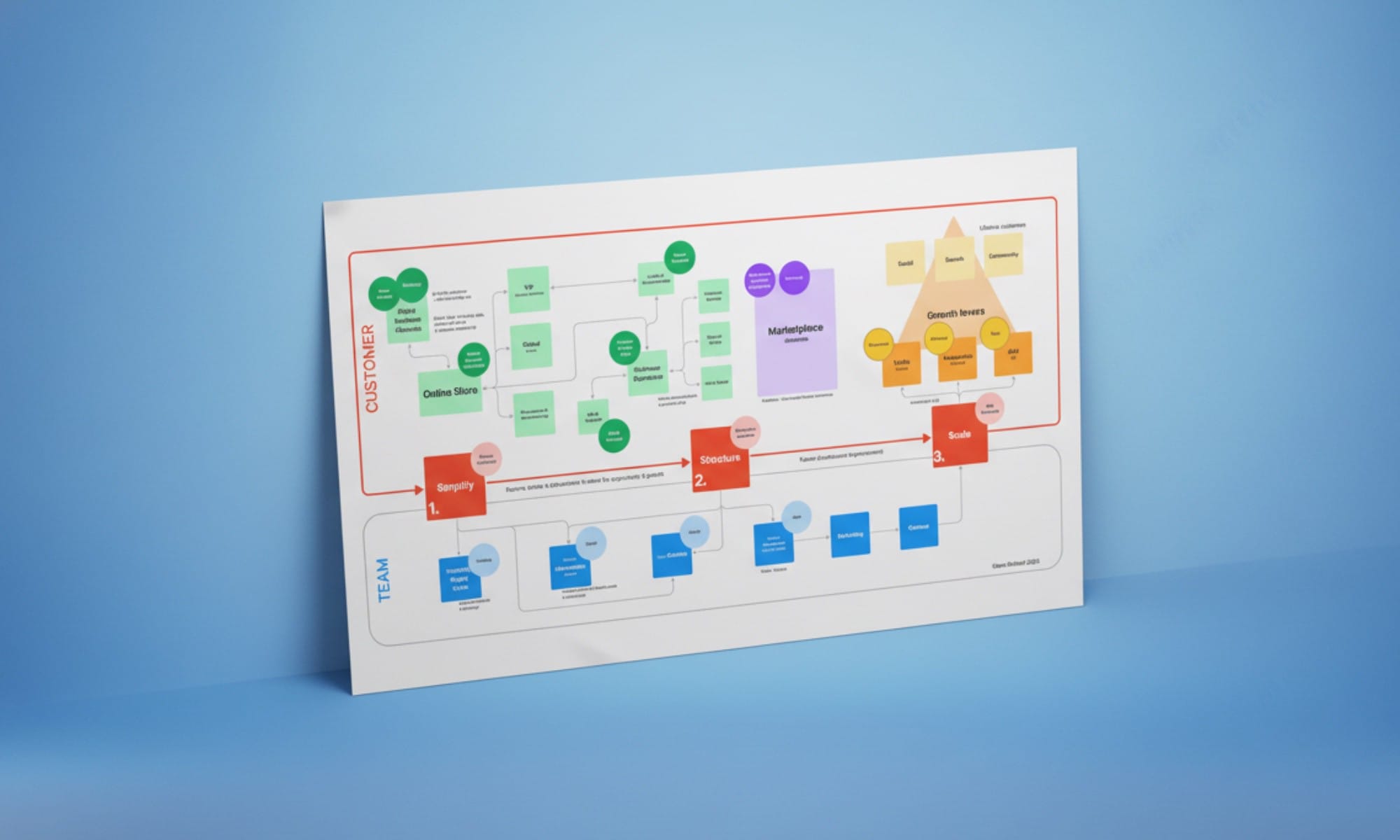
Get the Simplify Structure & Scale PDF & Figma file link so you can customise it for your own business.