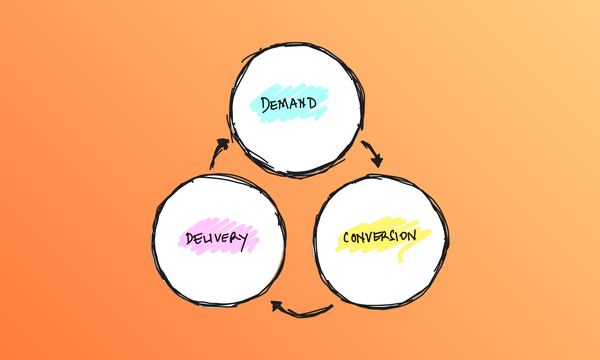
Every ecommerce business runs on the same three stages. Demand. Conversion & Delivery. Miss one, and the whole system underperforms. Over-invest in one while ignoring the others, and growth stalls in ways that are hard to diagnose.
Most founders know this intuitively. We spend money on ads, optimise our product pages, ship orders on time, and send follow-up emails. The problem is we treat these as separate jobs on separate to-do lists, managed by separate people. We lose sight of the system.
The Demand, Conversion, Delivery model is a way to see our business as a connected whole. Each stage feeds the next. The output of one becomes the input of another. When we understand this, every decision gets clearer.
Let's walk through each stage and how they connect.
Demand
Generating demand for the product we sell and the promises we make
Demand is everything we do to make potential customers aware we exist and interested in what we sell. Marketing campaigns, advertising, PR, events, market expansion into new segments or geographies. It also includes the less obvious drivers: the words and ideas our brand owns in customers' minds, the definition of our core customer, and the products and services we choose to offer.
This last point matters more than most founders realise. Our product range is a demand driver. The decision to stock a particular category or launch a new product line shapes who pays attention to us in the first place. New product development belongs here because it creates new reasons for new people to care.
Brand promises live in Demand too. The commitments we make (fast shipping, ethically sourced materials, a satisfaction guarantee) attract specific types of customers. These promises are demand signals. They tell potential buyers what kind of company we are before they ever visit our site.
The trap in the Demand stage is measuring activity instead of quality.
We track impressions, clicks, and traffic. These are fine as directional signals, but they tell us nothing about whether we're attracting people who will convert and stay. A Demand strategy built on volume alone loses people at every subsequent stage. We attract visitors who don’t convert and buyers who never return.
Conversion
Converting demand into revenue
Conversion is where attention becomes commitment. A visitor becomes a customer. This is the stage most founders obsess over, and for good reason. Small improvements here compound across every visitor we attract.
The drivers of conversion are psychological as much as technical.
Social proof (reviews, testimonials, user-generated content) reduces the uncertainty a buyer feels when considering a purchase. Authority (expert endorsements, certifications, educational content) builds confidence that we know what we're doing. Scarcity and commitment (wishlists, saved carts, limited editions) create momentum toward a purchase decision.
Conversion runs deeper than persuasion tactics.
Liking matters. The emotional response a customer has to our brand, our visual identity, our tone of voice, shapes whether they buy. Utility matters. Our product needs to solve a real problem, and that solution needs to be communicated clearly on the page. Value matters. The customer needs to believe what they're getting is worth what they're giving up in money, time, and effort.
Messaging ties all of this together. The specific language we use on product pages, in emails, and throughout checkout either builds or breaks the case for buying. Effective messaging speaks to what the customer cares about, not what we want to say.
The trap in Conversion is optimising for the first purchase at the expense of everything that follows. Aggressive discounting converts browsers into buyers, but it also trains customers to wait for sales. Scarcity tactics work once, but if every email screams urgency, trust erodes. The conversion strategies that compound are the ones rooted in genuine value: clear communication, strong products, and promises we intend to keep.
Delivery
Delivering on the promises we make along the way
Delivery is where the business proves it meant what it said. Production, stock management, supplier relationships, fulfillment, returns handling. This is the operational backbone. It's less glamorous than marketing and less analysed than conversion, but it's where customer trust is won or lost.
Stock management alone shapes more of the customer experience than most founders acknowledge. Out-of-stock products don't generate "lost sales" in an abstract sense. They generate real disappointment in real people who were ready to buy. Forecasting demand, managing suppliers, and maintaining appropriate inventory levels are customer experience decisions disguised as operations tasks.
Fulfillment is the moment our brand becomes tangible.
The package arrives. The product is unwrapped. This physical experience either confirms or contradicts every promise we made during Demand and Conversion. If we promised premium quality and the packaging feels cheap, we've created a gap between expectation and reality that no amount of marketing will fix.
Returns are part of Delivery too, and they deserve more strategic attention than most businesses give them. A well-designed returns process turns a potential negative into a trust-building moment. A frustrating one turns a recoverable situation into a lost customer. Returns data also feeds back into the system. High return rates on specific products signal problems in how those products are described, photographed, or manufactured.
The trap in Delivery is treating it as a cost centre to be minimised rather than an experience to be designed.
Every dollar saved on cheaper packaging, slower shipping, or understaffed warehouses has a cost somewhere else in the system. It shows up as lower retention, worse reviews, and weaker word of mouth. These are Demand and Conversion problems with Delivery root causes.
And the result is.... Retention
The long term benefits of getting the first three stages right
Retention is the result of a linear funnel becoming a circular system. When we retain customers, they re-enter Demand through word of mouth and referrals. They convert faster on repeat purchases because trust is already established. They're more forgiving of Delivery hiccups because they have a relationship with the brand.
The drivers of retention are communication, ongoing value, community, product quality, and customer experience across every touchpoint. None of these are surprising. What matters is recognising that retention compounds in ways acquisition does not.
Communication with existing customers is different from communication with prospects. These people already know us. They've already bought. What they need now is relevance. Personalised recommendations, useful content, loyalty rewards that feel earned. The goal is to demonstrate that we value the relationship, not extract more from it.
Community is an underused retention lever for most ecommerce brands.
When customers connect with each other around a shared interest or brand affinity, switching costs increase naturally. The brand becomes part of a social identity, not a transactional relationship. This is difficult to build and impossible to fake, but brands that manage it create a competitive advantage that paid acquisition cannot replicate.
Product and service quality is the foundation of all retention. If our products consistently meet or exceed expectations, retention takes care of a large portion of itself. If they don't, no loyalty programme or email sequence will compensate.
The trap in Retention is treating it as a marketing function. Retention emails and loyalty offers are useful tools, but they're surface-level interventions. Real retention comes from the quality of the entire experience: the product, the delivery, the support, the sense that this company cares about the same things I care about. Retention is the report card for the whole system.
The system as a whole...
The stages are useful as categories, but the real value of this model is in seeing the connections between them.
Demand quality determines Conversion efficiency. When we attract the right people with honest messaging, they convert at higher rates because the product fits their needs. When we attract the wrong people with inflated promises, we get traffic that doesn't convert and customers who don't stay.
Conversion choices affect Delivery load. Aggressive promotions spike order volume, straining fulfillment capacity.
Products sold with unclear descriptions generate returns that clog operations. Pricing that's too low to sustain quality leads to cost-cutting in Delivery that customers feel.
Delivery execution feeds the customer experience and in turn, retention.
A flawless fulfillment experience builds trust. A damaged package or a slow resolution to a problem destroys it. The operational decisions we make every day show up in retention metrics weeks or months later.
Retention drives Demand. Satisfied customers tell people. They leave reviews. They share on social media. They come back and buy again without being asked. This organic demand is more valuable than any paid channel because it arrives pre-qualified and pre-trusted.
When we see these connections, we stop trying to solve traffic problems or conversion problems in isolation. We start looking for the weakest link in the system, the stage where improvement would create the biggest ripple effect across the others.
That's the value of thinking in systems. Every business has a bottleneck. This model helps us find it.