

A cheap ad click is not always what we want
Ad click-through rising while add-to-cart per click falls means the creative is recruiting the wrong audience. Both rising means it's working. Both falling means you have a creative problem of the ordinary kind, and that one's much easier to fix.
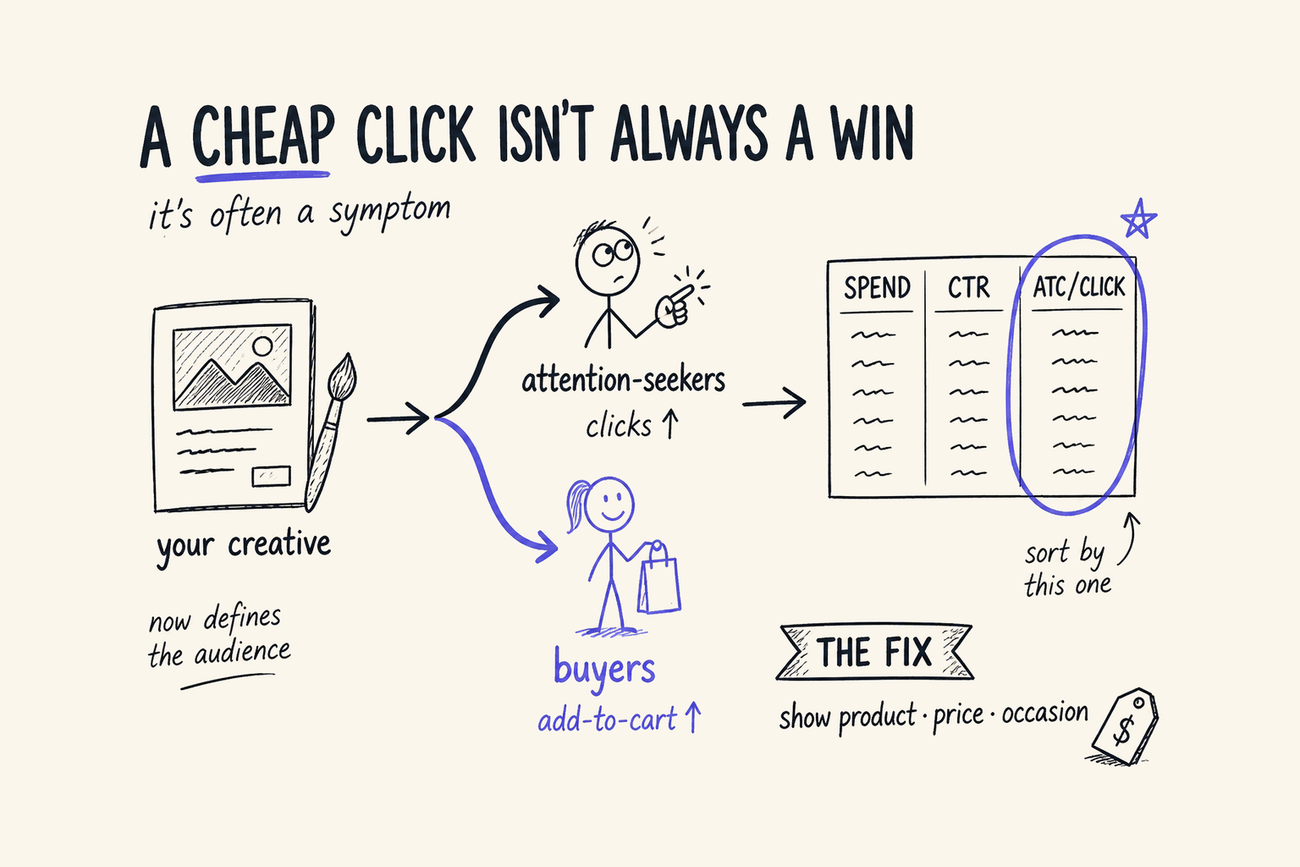
Here's what I’m seeing in client ad accounts… click-through rising while add-to-cart per click falls means the creative is recruiting the wrong audience. Both rising means it's working. Both falling means you have a creative problem of the ordinary kind, and that one's much easier to fix.
Video used to click badly and sell well. So what happened?
Last year it was the worst-clicking format in this ad account and the best-earning one. This year it's the best-clicking and the worst-earning. Same brand, same account, the same two formats sitting side by side in it.
That swap is the most useful thing I've seen in a paid media report in a long time, and it took me a second to work out why it mattered.
The account belongs to a retail brand I work with. Considered purchases, an average order comfortably over a thousand dollars, a bit over $300k of paid media across the quarter against just under $3m of sales. Meta takes most of the spend & Google most of the rest. Orders fell by close to 30% against the same quarter last year. Sales fell 15%, because the average order climbed and covered some of the gap.
The agency’s read was that traffic quality had gone off. Which is true, and it's also the kind of comment that gets a nod in a meeting and we all move on because nobody can really do anything with it.
Let's compare apples with oranges
Every year-on-year number in a Meta account right now is contaminated and it's worth knowing why before you read anything into one.
Through to the end of May, Meta changed what it counts. The engaged-view threshold halved and incremental attribution arrived, measuring lift rather than last click. Click reporting has also narrowed to genuine link clicks. Reported conversions this year are a different thing from reported conversions last year, and in this account Meta's reported add-to-cart rate more than halved in the single month that rollout completed. Nobody touched a thing. Most of the arguments happening about ad performance this year are people comparing two numbers that aren't the same number - effectively comparing apples with oranges.
I stopped comparing years and compared the two formats inside each year instead.
In 2025, video clicked at about two-thirds the rate of image and returned about a quarter more.
In 2026, video clicks around ten per cent more than image and returns about fifteen per cent less.
Both comparisons run under the same rules on both sides, so there's nothing to argue about. The rank order of the two formats inverted, and the inversion is real.
And the store's own numbers say the same thing from the other side. Site-measured add-to-cart rate, which is first-party and has nothing to do with Meta's definitions, fell by about a third across the quarter and by half in the worst month, on 10% more sessions. More people arriving. Fewer of them picking anything up.
And Google says it too. Google's attribution didn't move this year, so its numbers are comparable in a way Meta's aren't, and its conversions fell by a third in the same month everything else broke, on more money than last year, not less.
So when did good creative stop being good creative?
Meta rebuilt its ad retrieval system through last year. The short version is that matching shifted from audience parameters to creative signals. Your targeting used to decide who saw the ad. Your creative does most of that job now.
And this changes our definition of what a piece of creative is. It's stopped being the thing you put in front of an audience and started being the thing that defines the audience.
Creative that earns attention goes and finds you more people who pay attention. Creative that carries the product, the price & the occasion goes and finds you people shopping for that thing. Both work exactly as designed. One of them buys you a great looking click-through rate and an empty cart, and it'll probably do it cheaply, which is the part that makes it hard to see. Think about what that does to a creative review. Every instinct in the room is trained on stopping the scroll, and stopping the scroll is now a targeting instruction.
And here's the part that rests with the founder rather than the media buyer. There's no longer a control to correct it with. Interest exclusions went in 2024. The prospecting and retargeting budget split went early last year. Placement exclusions went in August, so you can't opt out of Reels now even if you want to. Google's travelled the same road, and in this account Performance Max carries over 70% of the Google spend with no keyword, placement or audience control inside it either.
A year ago, delivery drifting toward the wrong pocket of the audience was something you fixed in the settings. Now the only thing that moves it is what the creative asks for.
High click-through isn't always bad
I have to be careful here, because the obvious lesson from all this is wrong.
The best campaign in this account by a distance is a product range campaign that clicks at nearly three times the account average. Highest add-to-cart rate of anything large, best return, and a cost per reported purchase at less than half the account average. This thing clicks like mad and sells like mad.
A high click-through isn't the problem on its own. A high click-through with a low add-to-cart rate underneath it is the problem, and those two campaigns can look identical on the dashboard we’re looking at.
Two of the campaigns in the same account do the thing we don’t want. One pulls a click-through well above account average and then converts to cart at below it. The other one is starker. It clicks above average and puts 1.2% of those clicks into a cart, less than a third of what the account manages. Between them they took more than 13% of the budget and they're the two campaigns training delivery hardest toward people who were never going to buy anyway.
Keep an eye on this
So what do you monitor now?
A click-through ceiling, not a cost-per-click floor.
A cheap click used to be a small win worth chasing. Now it's a symptom and what it's usually telling you is that the algorithm has found a cheap pocket of inventory full of people who like looking at things. Looking on the bright side, it's possibly the easiest number in the account to be pleased about - but for the wrong reason.
So here's what I’m seeing… click-through rising while add-to-cart per click falls means the creative is recruiting the wrong audience. Both rising means it's working. Both falling means you have a creative problem of the ordinary kind, and that one's much easier to fix.
Read it campaign by campaign rather than account-wide. Account averages will hide this, because a campaign doing the good version and a campaign doing the bad version average out into a number that looks like nothing much happened.
Here’s what I'd do
I'd pull three columns for every campaign that took real money last quarter - spend, click-through & add-to-cart per click - and sort by the last one. Not by return. Not by cost per purchase. Both sit downstream of an attribution system that shifted this year. That's an afternoon's work and it'll tell you which of your campaigns are buying attention and which are buying customers.
Then take your worst two by that measure and look at the creative rather than the settings. The question isn't whether it's good. It's what it asks for. A piece of creative with no product, no price & no occasion in it is asking the machine to go and find people who enjoy looking, and the machine is very obliging.
And I'd put a promotional moment in the calendar. The platform can optimise against intent that already exists, but it can't manufacture intent that isn't there, and the offer is one of the very few direct levers still sitting on your desk.
I'm no engineer and I can't see inside the retrieval system any more than anyone else outside Meta can. I can be wrong about the why. What I'm reasonably sure of is the pattern. Click-through up, carts down, and no setting left to fix it with.
Go and look at your two best-clicking campaigns from last quarter. Check what percentage of those clicks actually put something in the cart.


Discussion