

Conversion Attribution: When 4 Platforms Claim the Same Sale
Attribution decides who gets the credit for a sale, not whether it happened. Switch the rule and the channel you were ready to cut can look twice as valuable.

Your dashboard applies a rule about who gets the credit for a sale. Change the rule, and the channel you were about to cut can double in value.
Every quarter, in a review somewhere, a founder looks at a table of channels and gets ready to cut the one at the bottom.
Meta, usually. Or the newer social channel that “isn’t converting” - yet. The dashboard says it’s weak. The call feels obvious.
But before you make it, have a look at what the dashboard is doing. It’s applying a rule about who gets the credit for the sale. Change the rule, and the channel you were about to cut can double in value without a single thing changing in the business.
That’s the whole idea. Attribution is a lens for a decision, not a verdict on a channel. Let me show you, with real numbers.
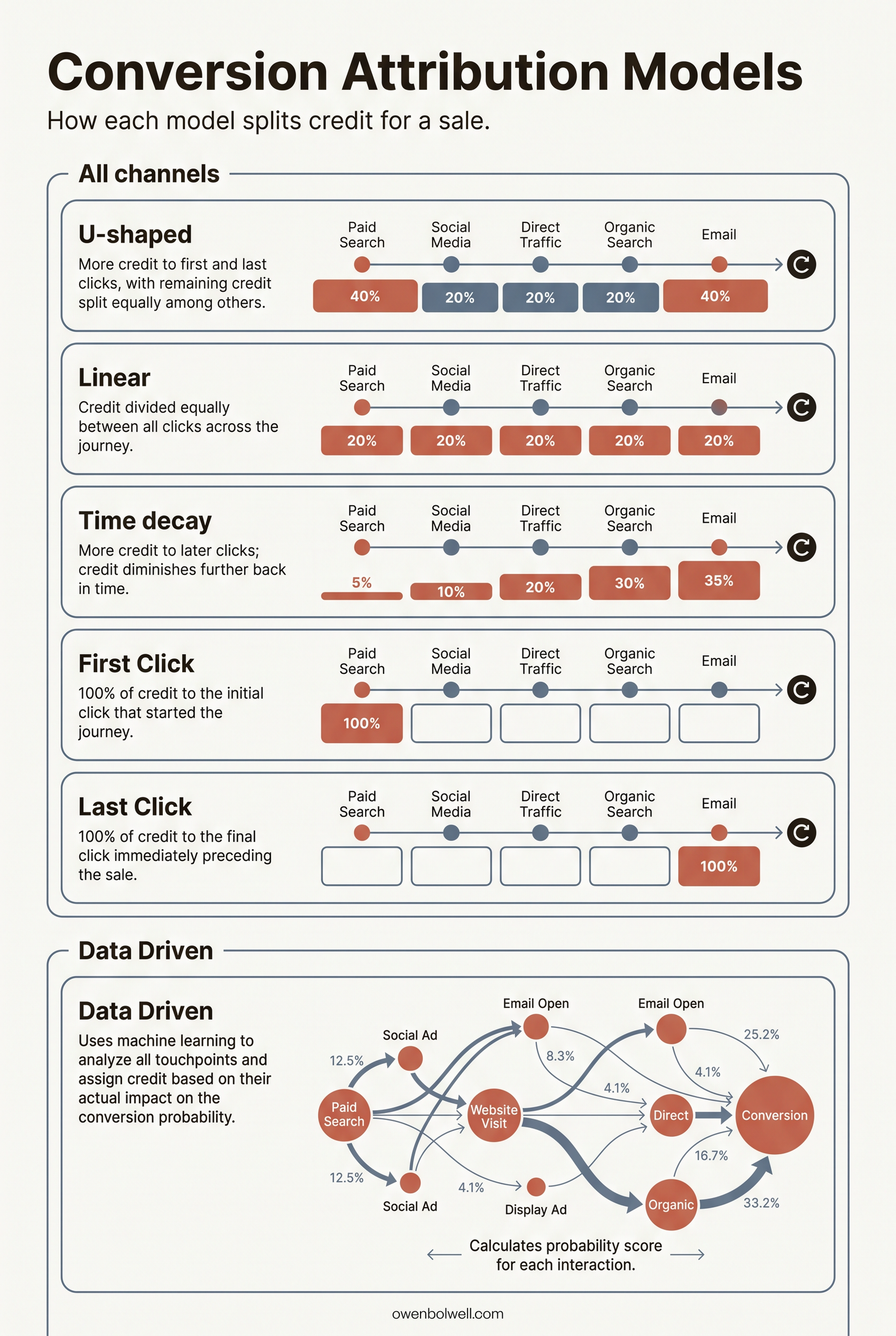
I ran the numbers four times
I pulled the data for a brand I work with. One quarter. Around $4M in tracked revenue. I ran the same period, the same channels, four times over, changing only the attribution model each time.
The total never moved. It sat at that $4M every time. Where the credit landed moved a lot.
Facebook Ads nearly doubled. On last-click it looked like the weakest of the big channels. On a model that shares credit across the whole journey, its number came out close to twice as high. Same spend, same customers, same quarter.
Google Ads swung by more than a third, depending on whether you handed the credit to the first touch or the last.
Email moved by around half on the same basis.
Same sales. Same customers. The only thing that changed was the rule about who gets the credit.
Let’s think about what that does to the review. On last-click, Facebook is the weakest of the big channels and first on the chopping block. Read the same quarter through a model that shares credit across the journey, and it’s pulling nearly twice its weight. Both numbers are real. Neither is the whole truth. They’re two lenses on one event.
No model survives a three-month journey
There’s a reason all four numbers exist and all four hold up.
For this brand, the average path to purchase runs the best part of three months. Only about one in five sales came from a single touch. The rest took two or more, and a real tail ran well into double figures before the order landed.
Attribution is trying to take a journey that long, across a dozen touchpoints, and squeeze it into one line that says “Google did it”. Of course it can’t. No rule can. The customer met you on Instagram, forgot you, saw an ad, opened an email, searched your name, came back a month later, and bought.
Which touch made the sale?
All of them. That’s the answer, and it’s the one a single number can never give you.
Google Ads didn’t win that customer alone. It closed a customer that organic social and email had already warmed up. Judge it as a solo performer and you’ll over- or under-pay it. Judge it as one part of the system and it makes sense.
Using the lens without screwing things up
None of this makes attribution useless. It makes it a lens. Here’s the pattern I’ve found works.
Pick a primary model and stay consistent with it, so your numbers mean the same thing from one week to the next. Then, before any big budget call, look at the same period through a second model. If a channel is strong on one and weak on the other, you’ve learned it plays a role you can’t see from one angle. That’s information, not a failing of your analytics.
Watch the blended number. Total revenue over total marketing spend, across everything. It tells you whether the whole machine is getting more or less efficient, and it doesn’t care which model is used. When the per-channel numbers argue with each other, the blended trend is your tie-breaker.
Triangulate the three views you already have. The ad platform’s own number, your analytics, and your blended efficiency will never agree. That’s fine. Each was built to measure a different thing. Use the platform number to optimise inside the platform, use your analytics for direction and blended for the truth about the whole.
And when it matters whether a channel is earning its place, don’t argue about the models. Test it. Turn the channel down or off for a set period and watch what happens to total sales. That answers the one question no model can: what would we have sold without it?
The question was never which channel gets the credit. It’s what’s the smallest change to the mix that improves the whole store. You’re managing a team here, and a team isn’t ranked by who scored the last goal.


Discussion